
Table of Contents
- Introduction
- What is Web3?
- Why is Web3 important for digital marketing?
- Metrics to track for Web3 campaigns
- Unique Visitors
- Time on Site
- Engagement Metrics
- Conversion Rates
- On-Chain Metrics
- Community Metrics
- Cookieless Tracking
- Best practices for tracking Web3 metrics
- Define your goals
- Set up tracking tools
- Analyse and optimise
- Conclusion
- FAQs
As digital marketing continues to evolve, new technologies emerge to transform the industry. Web3 is one such technology, offering a decentralised approach to web development and data management. With the rise of Web3, it’s important for marketers to understand how to track metrics for their Web3 campaigns. In this article, we’ll explore the key metrics to track and the tools you can use to measure your campaign’s success.

1. Introduction
Digital marketing has become an integral part of modern business, with companies using various strategies to reach their target audience online. With the rise of Web3, a new era of web development and data management is upon us. Web3 technologies are built on decentralized infrastructure, where data is stored and managed on a blockchain network. This new approach presents unique challenges and opportunities for digital marketers. One of the most important challenges is how to track metrics for Web3 campaigns.
2. What is Web3?
tl;dr less trust, more truth.
Web3, also known as the decentralised web or the web of trust, is the next generation of the internet. It is built on decentralised infrastructure, where data is stored and managed on a blockchain network instead of on centralised servers. Web3 is designed to be more secure, transparent, and open than the traditional web. It enables individuals to control their own data, identity, and assets, without relying on intermediaries or centralised platforms.
3. Why is Web3 important for digital marketing?
Web3 presents several opportunities and challenges for digital marketers. First, it offers a new way of building and managing websites and applications, using decentralised protocols and tools. This can lead to greater transparency, security, and privacy for users, as well as new business models for marketers. Second, Web3 enables new forms of digital assets and currencies, such as cryptocurrencies and non-fungible tokens (NFTs), which can be used for various marketing purposes, such as loyalty programs and incentives. Third, Web3 presents unique challenges for tracking metrics and measuring the success of digital campaigns, as traditional tools may not be applicable or effective.
4. Metrics to track for Web3 campaigns
Tracking metrics for Web3 campaigns requires a different approach than traditional digital marketing. Here are some key metrics to consider:
Unique Visitors
The number of unique visitors to your website or application is a basic but important metric to track. It helps you understand how many people are interacting with your Web3 campaign and how well it’s reaching your target audience.
Time on Site
The amount of time users spend on your website or application is another important metric to track. It indicates how engaging and relevant your content is to your audience. A longer time on site also increases the likelihood of conversion.
Engagement Metrics
Engagement metrics, such as likes, shares, and comments, are important indicators of how well your Web3 campaign is resonating with your audience. They help you understand the level of interest and interaction users have with your content.
Conversion Rates
Conversion rates measure the percentage of users who take a desired action on your website or application, such as subscribing to your newsletter, joining your community or filling out a form. Tracking conversion rates is critical to measuring the success of your Web3 campaign and optimising it for better results.
On-Chain Metrics
On-chain metrics are key for Web3 projects and protocols, while these will vary from project to project, we can outline analogous web2 tracking metrics to web3. A tracking outline could look like:
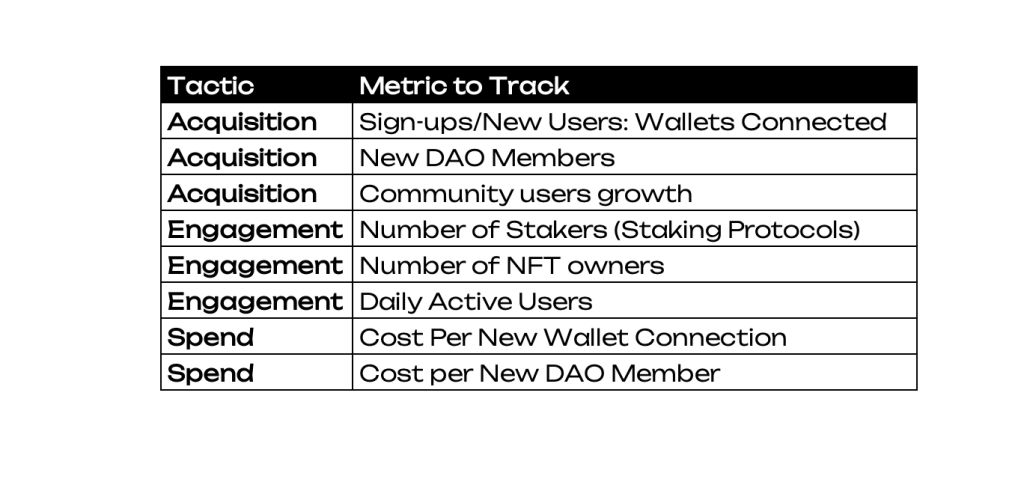
- Sign-ups/New Users: Wallets Connected
- Cost Per New Wallet Connection
- Number of Stakers (Staking Protocols)
- Number of NFT owners
- Daily Active Users
- New DAO Members
- Cost per New DAO Member
- Community users growth
5. Best practices for tracking Web3 metrics
To effectively track metrics for Web3 campaigns, here are some best practices to follow:
Define your goals
Before you start tracking metrics, it’s important to define your goals for the campaign. What do you want to achieve? Is it to increase engagement, drive conversions, or raise brand awareness? Defining your goals will help you identify which metrics to track and how to measure success.
Set up tracking tools
Once you’ve defined your goals, set up the tracking tools you need to measure your metrics. This may involve installing tracking codes on your website or application, or using third-party analytics platforms.
Analyse and optimise
Once you’ve collected data on your Web3 campaign, analyze it to identify areas for improvement. Use the insights you gain to optimize your campaign for better results.
Embrace A/B Testing
Server-side AB testing allows for running A/B tests without tracking any information on the user. This means that users are not aware that they are being tested. This type of testing is typically done through specialised software that allows website or app developers to experiment with different versions of the site or app and compare the results.
The main benefit of server-side AB testing is that it allows for more complex experiments, such as testing multiple variables simultaneously, without negatively affecting user experience. Additionally, because the testing is done on the server side, it can help mitigate privacy concerns associated with client-side tracking.
6. Cookieless Tracking
As the use of cookies becomes more restricted, businesses and marketers are turning to alternative methods of tracking users. In Web3, cookieless tracking is becoming increasingly important as users demand greater privacy and security. By implementing server-side tracking, browser fingerprinting, or local storage, businesses can continue to track user behavior and collect valuable data without relying on cookies. Due to the rise in privacy, cookieless tracking is expected on the Web3 space, this still allows for some data and analytics.
7. Conclusion
Web3 will continue to change technology and presents new opportunities and challenges for digital marketers. Tracking metrics for Web3 campaigns requires a different approach than traditional digital marketing and, while still evolving, allows us to develop a framework of a North star for our metrics.
 WEB3 AJB
Leave a comment